
Lease vs. Purchase for Healthcare Practices: Which Builds More Wealth Long Term?

One of the biggest financial decisions a healthcare provider will face is whether to lease or purchase their practice location. The right choice depends on your goals, your budget, and your stage of growth. Each path comes with trade-offs, and knowing how to evaluate them can save — or cost — hundreds of thousands of dollars over the life of your practice.
Why Many Practices Start by Leasing
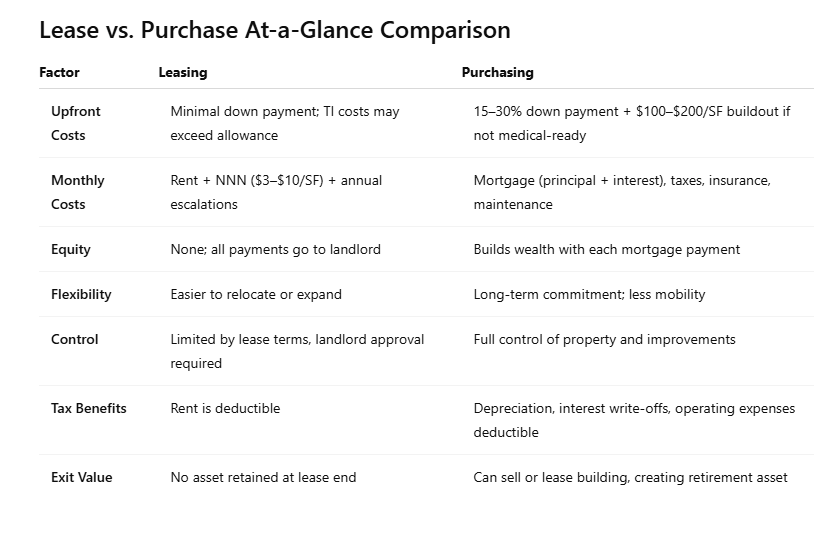
- Lower upfront costs: Leasing requires less capital, freeing cash for equipment, staff, and marketing. A typical dental or veterinary buildout can cost $100–$200 per square foot, and leasing allows you to allocate more toward clinical improvements rather than down payments.
- Flexibility: A lease allows a practice to test a location and adjust if patient flow or competition shifts. If demographics change, you aren’t tied to a building that no longer fits your needs.
- Speed to market: Leasing often provides a quicker path to occupancy compared to purchasing land and building, which can take 12–18 months or longer.
Takeaway: Leasing makes sense for new practices or those entering a new market, but it shouldn’t be the default forever.
The Advantages of Ownership
- Equity building: Every mortgage payment builds long-term wealth instead of paying off a landlord’s investment. Over 10–20 years, this creates a retirement asset in addition to your practice value.
- Control over improvements: Owners can invest in medical buildouts without worrying about future lease terms or landlord approvals. Upgrades like digital imaging, med gas, or specialty plumbing stay with your building.
- Stability: Ownership locks in occupancy costs and avoids renewal surprises. With leases, annual escalations (2–3% or more) compound quickly, while a fixed-rate loan creates predictable expenses.
- Exit value: A building can later be sold or leased to another provider, creating additional income or a nest egg for retirement.
Takeaway: For established practices, ownership often delivers stronger long-term financial returns.
Financial Comparison: Lease vs. Purchase
- Leasing Example: A 3,000 SF space at $25/SF NNN = $75,000 annual rent. With 3% annual escalations, that grows to nearly $87,000 by year 5. On top of that, NNN charges (which typically range from $3 to $10 per SF depending on property type and location) add significantly to annual occupancy costs. None of this creates equity. Tenants are also responsible for interior buildout if the space is not already medical-ready. While landlords may provide a tenant improvement (TI) allowance, it rarely covers the full cost — which often runs $100–$200 per square foot for healthcare-specific buildouts.
- Purchase Example: A $750,000 building with 20% down ($150,000) and a 20-year loan at 7% has annual payments around $63,000–$65,000. Much of this goes toward principal, building equity every year. Buyers must also budget for interior buildout if the property is not already suited for medical use — often another $100–$200 per square foot depending on scope.
While leasing may cost less upfront, purchasing often pencils out better over a 7–10 year horizon when equity growth is factored in.
Lease vs. Purchase At-a-Glance Comparison
Strategic Considerations
- Stage of practice: Start-ups often lease to stay nimble, then purchase once patient volume stabilizes.
- Market dynamics: In high-growth suburbs like Carmel, Fishers, or Greenwood, owning protects against escalating rents and shrinking availability.
- Tax benefits: Both leasing and owning have deductions, but ownership offers depreciation and interest write-offs that can improve long-term wealth.
- Exit strategy: If you plan to sell your practice, owning the building can make the transaction more attractive — or give you rental income if you keep the property.
Final Word
There is no one-size-fits-all answer to leasing vs. purchasing. For many healthcare providers, the right path is to lease early, stabilize, and then transition to ownership for long-term wealth building. The key is aligning your real estate strategy with your practice’s growth stage, financial goals, and market conditions.
📍 At Rise Realty Partners, we help healthcare providers evaluate both leasing and purchasing with real numbers and market insights. Whether you’re opening your first practice or preparing to buy your forever location, we’ll guide you step by step — ensuring your real estate decisions build not just your practice, but your long-term wealth.